
How recognizing and reorienting our attitude can take us further faster with the little-known concept of Pratipaksha Bhavana.
Hey Friend!
If you’re alive and at all connected to the Internet, you’re likely aware of the daily unpredictable and unprecedented changes in the world of cybersecurity that are both exciting and anxiety producing. Whether you are a whippersnapper or an old timer in the infosec industry, you’re noticing that the landscape is rapidly shifting, and it can feel challenging or overwhelming. From an almost daily onslaught of so-called ‘game changing’ releases to the rise of automation breeding new forms of scarcity or amazement, we’re on a wild journey.
Feelings like confusion or frustration can keep us from noticing possibilities and opportunities as they arise. As a noob or a pro, it’s likely you’re feeling the push to incorporate some form of AI into your life. It’s worth acknowledging that access to resources, time, and your current employment status might be framing your perspective. Whether you are responding with abject resistance or unabashed adoption, your attitude plays an invisible part in how you are making choices.
When most of us think about our choices, we often think we are rational and intelligent, and therefore approach decisions with care, consideration, and a measure of self-control. Ask friends and loved ones whether they agree, and we’ll all laugh and remember that humans are messy. That’s part of life. We choose, often without realizing what choice we’ve made, without attention to the future impacts of our choices.

Allow me to borrow a concept from Chris Hadfield‘s book “An Astronaut’s Guide To Life On Earth” about attitude and control. In terms of achieving goals and arriving at a destination, Hadfield uses the concept of attitude as it relates to aviation. Attitude, in this sense, has to do with an aircraft’s orientation with the horizon. Hadfield, who is one of the most decorated astronauts in the world, says, “There’s really just one thing I can control: my attitude during the journey, which is what keeps me feeling steady and stable, and what keeps me headed in the right direction; I consciously monitor and correct it if necessary, because losing attitude would be far worse than not achieving my goal.”
That’s great Aqeel, an astronaut is a high bar to meet. What’s something more realistic that will help me navigate my personal and professional trajectory?
Here’s my suggested playbook on how to cultivate an awareness of your attitude and how to course-correct.
Ask Yourself Some Hard Questions
If you’re finding that your decisions or emotions aren’t moving you towards what is important for you, asking yourself questions that help you reflect and evaluate is a useful strategy. Despite the grindset culture that gets likes or follows, being a human in process is non-linear and progress is not the aim here. Some example questions are:
- What am I not seeing? What are my blind spots?
- Where have I become complacent? Where am I being too ambitious?
- Is it okay for me push through this challenge? Is it better for me to rest and restore?
Reframe Your Perspective
Something I realized years ago was that I often encountered resistance within myself when I felt like I had or was supposed to do something. Does that feel familiar? What helped break the habit was reframing stressful or challenging situations into something that felt more easeful or expansive. Here are two examples:
Where I mentioned above my sense of obligation would make me bristle, I looked to see what I was inspired to do in a situation. Instead of feeling the heaviness or resentment that I usually did, I noticed myself feeling more inquisitive and playful.
Similarly, if I found myself met with great confusion, I would often experience a level of frustration that would urge me to throw my hands up or argue. Instead, I looked through the feeling of confusion to find the curiosity that drove me to the problem.
Cultivate the Opposite: Pratipaksha Bhavana
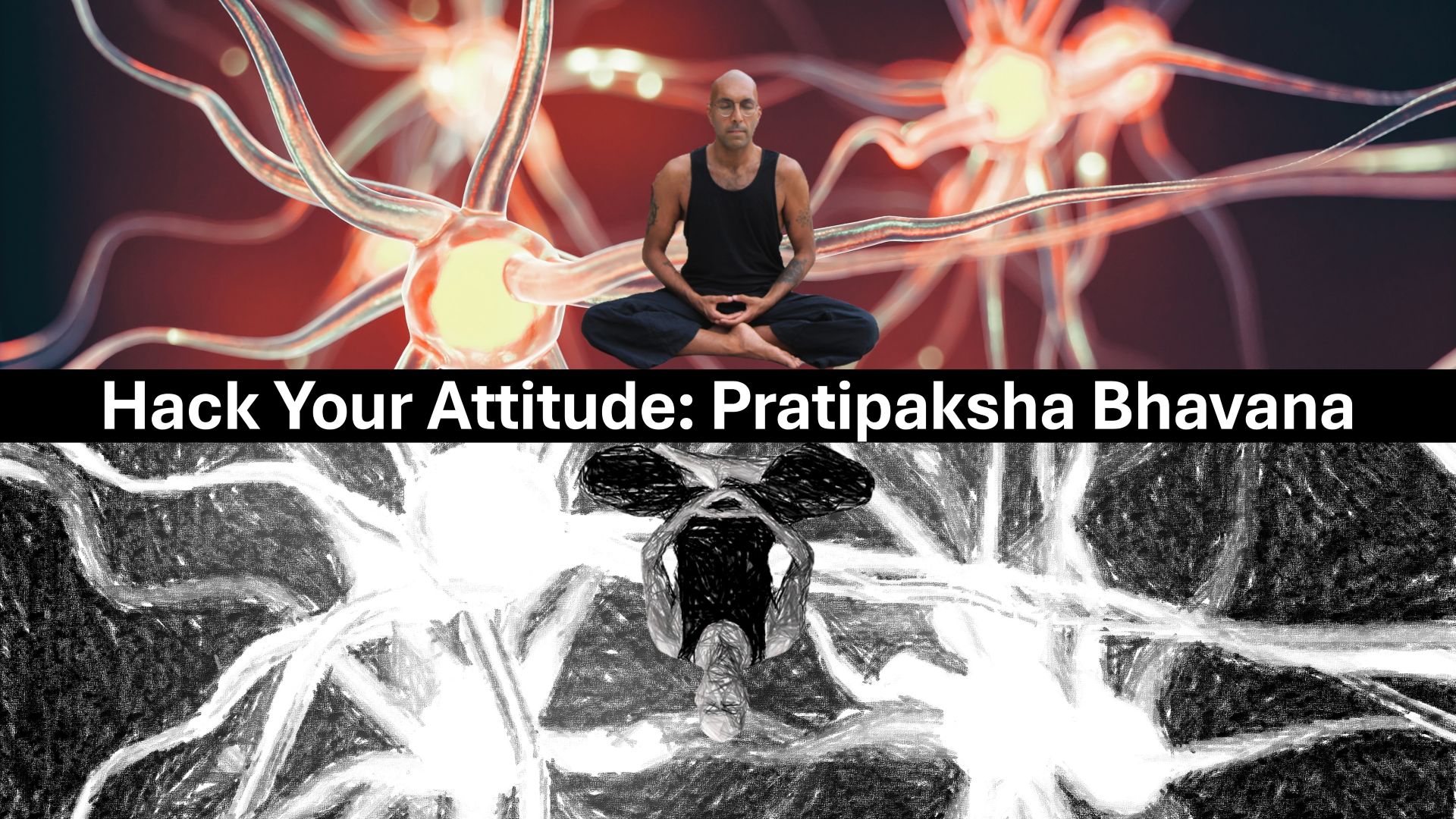
With this in mind, I’d like to introduce you to the practice from the Yoga Sutras of Patanjali called pratipaksha bhavana. The Yoga Sutras are a collection of aphorisms which, depending on whom you ask, are attributed to wise practitioners from between 500 BCE and 200 CE. In any case, the practice is simply taking a thought and meeting it with its opposite. Looking at its literal translation from Sanskrit, pratipaksha means “opposite” and bhavana means “cultivation.” Although it is all too human to take positive thoughts and attribute negative intentions, it is the yogic practice and tradition to ground our experience in reality, which is itself neutral, and therefore turn destructive thoughts into positive affirmations.

As a mental exercise, it is genuinely powerful to reframe and retrain your thoughts to intentionally transform a harmful thought into a helpful one. As an example, think of this situation. You’ve had a long stressful day, and you’re in a crowded elevator or on the subway home, when someone begins to hum. Because of your current mindset, you immediately think, “I hate when people hum,” and your attitude immediately shows on your face. I truly believe that most people don’t want the weight of stress on their backs and would prefer not scowling to the rest of the world. So, now imagine trying the opposite. First, recognize your emotion and the physical manifestation of your look. Then remind yourself that honestly, I don’t mind humming. But then take it one step further and actually think, “I love when people hum! How wonderful that they feel free to share their joy with everyone!” This simple act of thinking the opposite will make you start to notice the intensity of feeling and power of that thought and begin to diminish the negative mindset quite rapidly. In fact, your facial expression will most likely change just as quickly.
The technique works for any thought in the sense that our mind is a collection of thoughts, feelings, and memories that are subject to change either by habit or sheer force of will. This is just one of many tools in the science of yoga that can profoundly impact one’s relationship to thoughts, words, and eventually actions. I’ll leave it to you to decide how best to utilize the technique with the reminder that compassion is the tool that must always come first.
Think Before You Act
In a world dominated by immediate reactions and dopamine hits, it’s important to remember what we’ve always been taught: Think before you act. It is tempting to react immediately when stressful or challenging situations arise. However, slowing down to think, or at least feel what you’re feeling, can be the difference between a prolonged conflict and a solution that works for everyone. When thrust into a negative situation, even if you pause for a measly 5 seconds to think, your outcomes are usually much more productive and in turn usually less biting. Waiting even longer only increases the probability of a successful conclusion to what would otherwise be a long, drawn-out downward spiral of stress.
We’re all familiar with the common recommendation in our world of technical comms of not responding to a contentious email or text immediately with your initial emotional reaction. And sometimes not hitting send at all is the best reply! We all know this is true even without some mystic recommendation from long dead yogis. Now imagine taking your natural instincts and supercharging them with the forethought of opposite cultivation.
The entire purpose of pratipaksha bhavana is not about actions; it’s all about thoughts. With enough practice, this technique will get faster and eventually become part of who you are. With enough time, implementation becomes almost instantaneous. But it does require intentionality and repetition.
Your Turn to Try Pratipaksha Bhavana
Let’s repeat the exercise but with something top of mind. Without context and using the above examples as your guide, take a few minutes to think about the following:
AI and the Cybersecurity Workforce
Now, cultivate the opposite!
Embrace Curiosity
I’ll leave you here with an invitation to embrace curiosity.
Curiosity is the willingness to be surprised, beyond expectations, and discover what is possible. Without curiosity nothing is accomplished. Equally, nothing we do creatively is ever distinct or separate from the efforts and energies of others. In modern times, almost all great inventions and discoveries are collaborative efforts. Teams of people working toward proving theories or testing hypotheses have always been the co-authors of our great bodies of scientific and technical knowledge. AI or not, the necessity for human intelligence (not just intellectual) to be a determining factor in how humans experience nature, each other, and the mysteries beyond our current understanding remains true.